
SLXT135 – Tee 135º
Solinox Chimney Systems
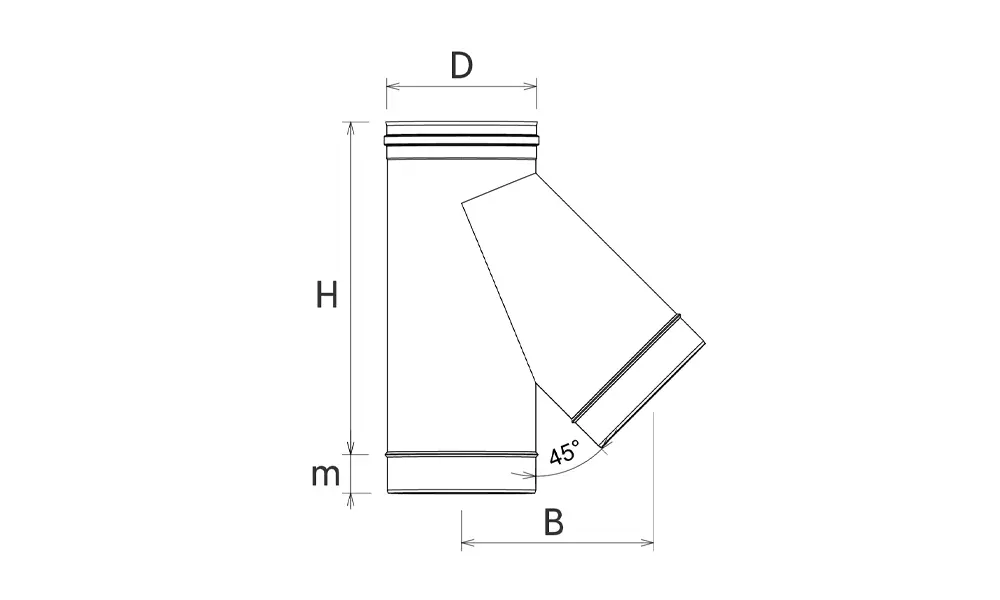

Technical Specifications
| D | 80 | 100 | 130 | 150 | 180 | 200 | 230 | 250 | 280 | 300 | 350 | 400 | 450 | 500 | 550 | 600 |
| H | – | 283 | 283 | 350 | 450 | 450 | 550 | 550 | 550 | 650 | 650 | 950 | 950 | 950 | 999 | 1247 |
| B | – | 175 | 180 | 215 | 275 | 275 | 330 | 330 | 330 | 390 | 400 | 555 | 565 | 570 | 580 | 700 |
| m | – | 50 | 50 | 50 | 50 | 50 | 50 | 50 | 50 | 50 | 50 | 50 | 50 | 50 | 50 | 50 |
Solinox Product Catalog
Technical Module
Certificates
Installation Video
Can’t find what you’re looking for?
Contact
Discover the SLXT135 Tee for Single Wall Chimney Systems
The SLXT135 Tee 135º provides an angled branch connection within a modular flue route. Where the layout calls for a branch to approach the main line at 135º, this dedicated component makes that geometry straightforward to specify. It belongs to the Solinox Single Wall Chimney Systems product range.
- Forms an angled connection at 135º.
- Supports layouts where a perpendicular tee does not match the design.
- Coordinates with compatible components in the SW range.
Why Choose an Angled Tee SLXT135
The angle of a branch affects how the entire chimney line is arranged. SLXT135 gives the designer an option when the equipment position and planned route call for an angled junction. Choosing the tee at the design stage also makes it easier to account for its height and branch projection.
- Matches a specified 135º branch layout.
- Provides a purpose-made junction for an angled connection.
- Helps plan the position of nearby pipe sections.
Applications in Single Wall Chimney Systems
The SLXT135 Tee can be considered for single wall chimney routes where a connecting line approaches the main flue at an angle. Its use should be based on the project drawing, the location of the connecting equipment and the dimensions available on site. The selected model must match the diameter of the adjoining system components.
- Angled branch connections in modular flue routes.
- Projects with limited space for the planned junction.
- Installations that specify a 135º tee geometry.
Solinox Integration and Product Selection
SLXT135 is most effective when selected as part of the complete chimney system rather than as an isolated fitting. Compare the product’s size-specific dimensions with the adjoining pipes and the available installation space. The technical table should guide the final diameter and connection choice.
- Check the required branch angle on the project plan.
- Verify height and projection for the selected diameter.
- Confirm compatibility with adjacent SW components.