
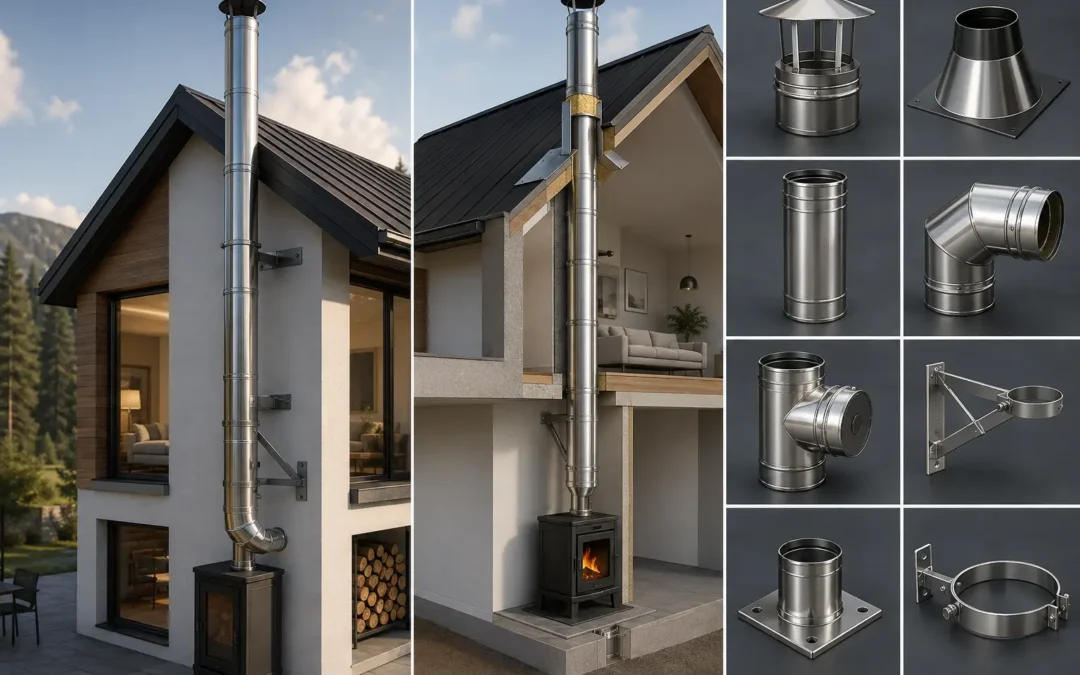
In industrial facilities, power plants, manufacturing sites, and commercial buildings, the terms chimney and stack are often used interchangeably. While both structures are designed to discharge gases safely into the atmosphere, there are important differences in their purpose, design, and application.
Understanding these distinctions is essential when selecting or designing a reliable chimney system for industrial operations.
What Is a Chimney?
A chimney is a vertical structure designed to remove smoke, combustion gases, and other byproducts from heating equipment, boilers, furnaces, fireplaces, or industrial processes. Its primary function is to create natural draft, allowing exhaust gases to rise and exit the building safely.
Chimneys are commonly found in:
- Residential heating systems
- Commercial buildings
- Industrial boilers
- Manufacturing facilities
- Power generation plants
A properly designed chimney system improves operational safety, enhances combustion efficiency, and helps maintain air quality standards.
What Is a Stack?
A stack is typically an industrial exhaust structure used to discharge process gases, emissions, or ventilation air at a sufficient height above ground level. Unlike traditional chimneys, stacks are often designed specifically for environmental compliance and emission dispersion.
Stacks are commonly used in:
- Chemical processing plants
- Refineries
- Power stations
- Waste treatment facilities
- Industrial manufacturing plants
Industrial stacks are generally engineered to optimize the dispersion of pollutants and reduce their concentration at ground level.
Key Differences Between a Chimney and a Stack
1. Primary Purpose
Chimney:
- Removes combustion gases from heating equipment.
- Creates natural draft for efficient combustion.
- Often associated with boilers, furnaces, and heating systems.
Stack:
- Releases industrial process gases and emissions.
- Focuses on pollutant dispersion and environmental compliance.
- Commonly used in large-scale industrial operations.
2. Draft Generation
A chimney often relies on natural draft created by temperature differences between the hot exhaust gases and the outside air.
A stack may operate with:
- Natural draft
- Induced draft systems
- Forced draft systems
- Mechanical ventilation equipment
3. Design Considerations
Chimney design generally emphasizes:
- Thermal performance
- Draft efficiency
- Corrosion resistance
- Fire safety
Stack design typically prioritizes:
- Emission dispersion modeling
- Wind loading analysis
- Structural stability
- Environmental regulations
4. Typical Height
Industrial stacks are often significantly taller than standard chimneys because greater height improves pollutant dispersion and reduces environmental impact.
The required height depends on:
- Local regulations
- Emission levels
- Facility size
- Environmental assessments
5. Construction Materials
Both chimneys and stacks may be constructed from:
- Carbon steel
- Stainless steel
- Reinforced concrete
- FRP (Fiber Reinforced Plastic)
- Specialized corrosion-resistant alloys
Modern industrial chimney system solutions frequently utilize stainless steel due to its durability, corrosion resistance, and long service life.
Selecting the appropriate chimney system requires careful consideration of operating conditions, environmental regulations, and material performance. By understanding the differences between chimneys and stacks, facility owners and engineers can make informed decisions that enhance safety, efficiency, and compliance.
Is every stack considered a chimney?
No. While both structures discharge gases into the atmosphere, stacks are typically designed for industrial emission control and dispersion rather than draft generation.
Which is taller, a chimney or a stack?
Industrial stacks are generally taller because they are designed to disperse emissions over a larger area and meet environmental regulations.
Can stainless steel be used for both chimneys and stacks?
Yes. Stainless steel is widely used in both chimney and stack applications due to its corrosion resistance, strength, and long service life.
Why is chimney system design important?
A properly engineered chimney system improves safety, combustion efficiency, environmental compliance, and overall operational performance.