
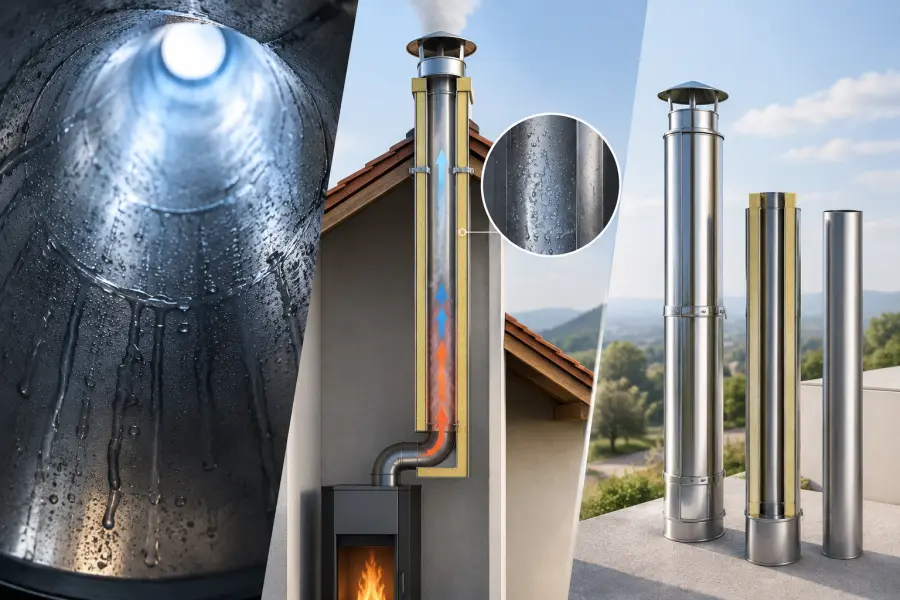
Condensation in chimneys occurs when hot flue gases cool down below their dew point inside the chimney system. During this process, the water vapour contained in the flue gases turns into liquid and can accumulate on the inner surfaces of the chimney. Solinox-Schornsteinsysteme can be planned according to the operating conditions of the heating system to help reduce the risk of condensation.
What Causes Condensation in Chimneys?
The main cause of condensation is the temperature difference between the flue gases and the chimney surface. When flue gases lose heat too quickly, water vapour can condense before it leaves the chimney. Solinox-Schornsteinsysteme are designed for different applications, and the selection of a suitable system should take the flue gas temperature and operating conditions into account.
Common factors that can increase the risk of condensation include:
- Low flue gas temperature
- Poor chimney insulation
- Incorrect chimney diameter
- Long horizontal flue sections
- Insufficient chimney height
- Frequent operation at low temperatures
How Does Condensation Affect the Chimney?
Continuous condensation can cause moisture to remain inside the chimney and may negatively affect the durability of some chimney components. Depending on the fuel and flue gas composition, the resulting condensate can also contain acidic substances that may damage unsuitable materials. For this reason, Solinox-Schornsteinsysteme should be selected according to the temperature, fuel type and technical requirements of the installation.
Proper system planning helps control the temperature of the flue gases and supports reliable flue gas discharge. The materials used in the chimney should also be resistant to the conditions created by condensation. Regular inspection can help identify moisture accumulation or damage at an early stage.
Flansch-Schornsteinsysteme and Condensation
Flansch-Schornsteinsysteme consist of individual chimney components connected through flange joints. Correct installation of these connections is important to prevent flue gas leakage and ensure that the system operates as intended. The system must also be appropriately dimensioned so that excessive cooling of the flue gases can be avoided.
When selecting Flansch-Schornsteinsysteme, several technical factors should be considered:
- Flue gas temperature
- Fuel type
- Chimney diameter
- Insulation requirements
- Operating conditions
- Installation environment
Einwandige Schornsteinsysteme and Condensation
Einwandige Schornsteinsysteme can be used in different applications, including certain renovation projects and installations within existing shafts. Since these systems generally have less thermal insulation than insulated chimney constructions, the temperature of the flue gases and the surrounding conditions should be carefully considered. Proper dimensioning and installation are important for reducing unnecessary heat loss and condensation risk.
When using Einwandige Schornsteinsysteme, the following points should be checked:
- Existing shaft dimensions
- Flue gas temperature
- Required chimney diameter
- Material compatibility
- Operating conditions of the heating appliance
Doppelwandige Schornsteinsysteme as a Solution
Doppelwandige Schornsteinsysteme feature an insulated construction that helps reduce heat loss from the flue gases. By keeping the flue gases warmer for longer, they can help reduce the conditions that lead to condensation, particularly in external chimney installations. This makes insulated systems a suitable option for applications where maintaining the flue gas temperature is important.
Another advantage of Doppelwandige Schornsteinsysteme is their suitability for different building and installation conditions. The insulation between the inner and outer wall supports stable operating temperatures and can contribute to reliable flue gas discharge.
How Can Condensation Be Prevented?
Preventing condensation starts with selecting and dimensioning the chimney according to the heating appliance and operating conditions. The chimney diameter, insulation, height and flue gas temperature should be considered together rather than individually. Solinox-Schornsteinsysteme can be selected according to the requirements of different heating and flue gas applications.
Important measures for reducing condensation include:
- Choosing the correct chimney diameter
- Providing adequate thermal insulation
- Selecting suitable corrosion-resistant materials
- Avoiding unnecessary cooling of flue gases
- Ensuring proper chimney height and configuration
- Carrying out regular maintenance and inspection
Why Is Professional Chimney Planning Important?
A chimney system should be designed as a complete system rather than selecting individual components separately. The heating appliance, flue gas characteristics, chimney structure and installation conditions all affect condensation behaviour. Solinox-Schornsteinsysteme offer different system solutions that can be adapted to the technical requirements of the application.
Correct planning also helps ensure that the chimney operates within the required temperature range. Solinox-Schornsteinsysteme can therefore be considered according to the building structure, heating system and expected operating conditions, helping to create a reliable and durable flue gas system.